Museums in Húsavík
Húsavík is home to several museums offering a closer look at everything from Iceland's Eurovision connection to the history of exploration, whales and local life. With four museums and just 2500 inhabitants, Húsavík has one of the highest concentrations of museums per capita in the world. In Iceland, we love to measure things per capita. Perhaps because as a nation of just 400 000 people, it's the only way to make our numbers look impressive.
We have the most cars in the world, per capita. The most swimming pools, per capita. The most Nobel Prize winners, per capita. One. And in 2008 we had one of the largest bankruptcies in history. That one actually wasn't per capita. But we do have the most Eurovision viewers per capita. In fact, around 96-99% of Icelandic TV viewers tune in for the Eurovision final every year. In 2021, when Daði og Gagnamagnið represented Iceland with "10 Years", RÚV1 had a staggering 99.1% share showing the band place 4th.
Eurovision Exhibition
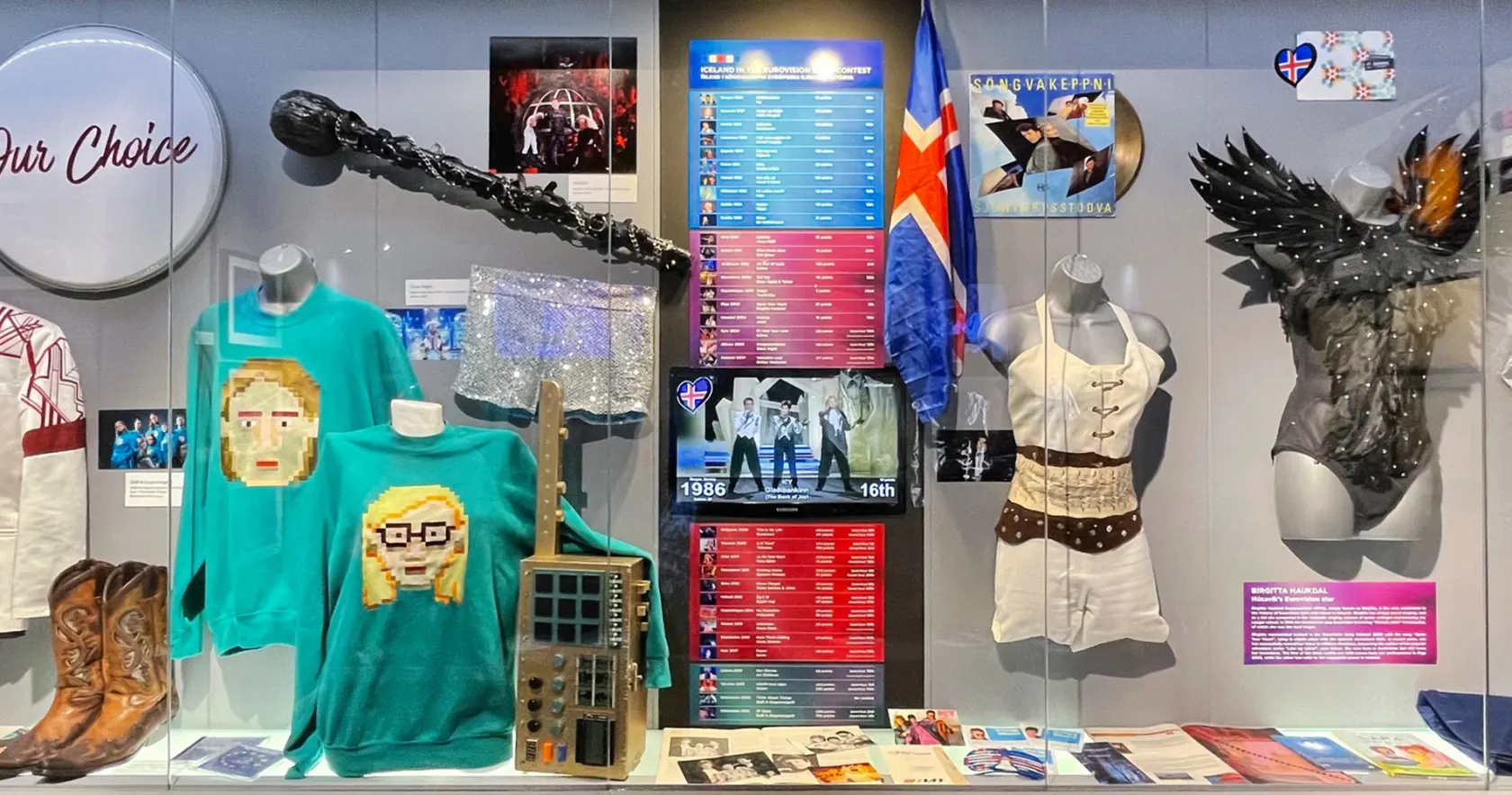
Therefore it's no wonder the only official Eurovision Exhibition in the world is located right here in Húsavík. The exhibition celebrates Iceland's long and wonderfully chaotic relationship with the Eurovision Song Contest. You'll find costumes, props and memorabilia from "Eurovision Song Contest: The Story of Fire Saga", the Netflix movie that put Húsavík on the Eurovision map and, depending on how you look at it, put Húsavík on the map in general.
You can see some of the costumes and props used in the film and learn more about the real story behind the fictional band Fire Saga. And the connection between Húsavík and the movie goes well beyond the name of a song. Much of the film was shot around Iceland, while Húsavík itself became the setting for the band's hometown and the emotional centre of the story.
The Eurovision story in Húsavík is not only about a Hollywood movie, though. The exhibition also looks at Iceland's history in the Eurovision Song Contest, from our early appearances to some of the performances and artists that have become part of Icelandic Eurovision folklore. In 2025, the band representing United Kingdom in Eurovision, Remember Monday came to Húsavík to film their cover of “Húsavík”, bringing the song back to the town that inspired it.
So whether you're a lifelong Eurovision fan, a Fire Saga enthusiast, or simply wondering why an Icelandic fishing town is so obsessed with a European singing competition, this is a fun place to find out.
The Eurovision Exhibition is one half of a rather unusual museum experience. Together with the Why We Explore Exhibition by the Exploration Museum, it gives you two museums for the price of one ticket, with both entrances located through Jaja Ding Dong bar, right next door to Hótel Húsavík.

Why We Explore – Exploration Museum
This exhibition by the Exploration Museum takes a fascinating look at humanity's urge to discover the unknown. From pioneering journeys to space exploration, it explores what drives us to push beyond the familiar. Why do we explore? Is it curiosity? Adventure? The desire to see what's over the horizon? Or perhaps simply the inability to leave a good mystery alone?
The Exhibition looks at humanity's urge to discover the unknown. From Viking voyages and polar expeditions to one of the greatest adventures of all: putting people on the Moon. And Iceland has a surprisingly important place in that story. In the 1960s, NASA sent Apollo astronauts to Iceland to practise geology and learn how to read and collect rocks in volcanic landscapes that could serve as analogues for the lunar surface. Astronauts trained in Iceland in 1965 and 1967, and the area around Húsavík became part of this remarkable chapter in space exploration. The Exploration Museum tells the story through photographs, artefacts and the experiences of the astronauts who trained here.
One of the most famous names connected to that story is Neil Armstrong. Yes, that Neil Armstrong. The first person to walk on the Moon. The museum has some extraordinary pieces connected to Armstrong and his life as an explorer, including the rock hammer he used during his geological work in Iceland. You can also see the sweater he wore when he travelled to the North Pole with Edmund Hillary in 1985.
It's a wonderful reminder that Armstrong's adventures didn't stop when he came home from the Moon. Alongside Sir Edmund Hillary, the first person to reach the summit of Mount Everest, he continued to seek out places that few people had seen before. And the story doesn't end in the 1960s. NASA still uses Iceland as a training ground for astronauts preparing for lunar exploration. Iceland's volcanic landscapes, basaltic rocks and barren terrain provide a remarkably useful analogue for parts of the Moon. Astronauts can practise reading the geology, navigating difficult terrain, working as a team and collecting rock samples in an environment that feels, in places, surprisingly otherworldly.
In 2024, the connection reached the Artemis programme. The Artemis II crew travelled to Iceland for geology field training as part of their preparation for their mission around the Moon. They trained in Icelandic volcanic terrain, working on navigation, field geology and rock-sampling techniques. Continuing a tradition that began with the Apollo astronauts more than half a century earlier. So when you look across Iceland's lava fields and volcanic landscapes, you're not just looking at some of the country's most spectacular scenery. You're looking at landscapes that have helped train people to explore another world.
Both museums are accessed through Jaja Ding Dong Bar, right next to Hótel Húsavík. You really couldn't stay much closer. And the next one isn't exactly far either. A short walk down the street and you discover...

Húsavík Whale Museum
Of course, Húsavík's most famous residents are not astronauts or Eurovision contestants. They're humpbacks, stinky-minkes, dolphins, fin whales and the largest mammals on our planet - blue whales. The gentle giants of our bay.
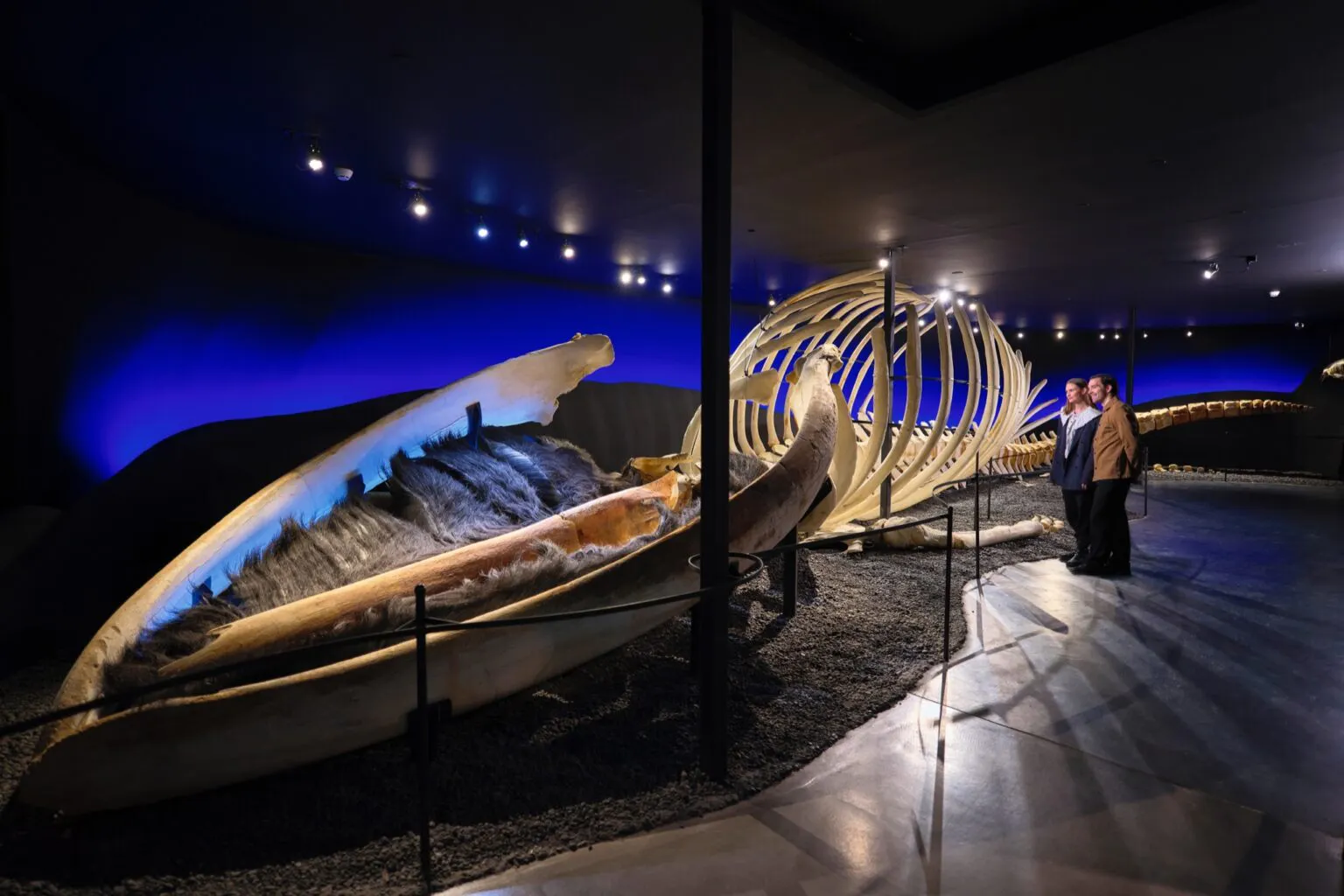
The Húsavík Whale Museum is one of the few museums in the world dedicated entirely to whales. Its eight exhibition rooms explore the biology, ecology and behaviour of whales, as well as the history of whaling and our changing relationship with these remarkable animals. The museum's collection includes 11 real whale skeletons, including an enormous blue whale skeleton measuring around 25 metres long. Seeing a whale of that size up close gives you a rather different appreciation for just how big these animals really are.
A visit to the Whale Museum pairs particularly well with a whale-watching trip. After seeing humpbacks, minke whales or dolphins out in Skjálfandi Bay, the museum gives you the chance to learn more about the animals you have just encountered and perhaps understand a little better what you're looking at when a whale's back or tail appears beside the boat.
Húsavík Museum
For a glimpse into the Húsavík of earlier generations, head to Húsavík Museum, or Safnahúsið in Icelandic. The museum explores everyday life and the relationship between people and nature in the Þingeyjar region, particularly during the period from 1850 to 1950. Rather than focusing on famous people and grand events, it tells the story through the objects, tools and personal experiences of ordinary people who lived and worked here.
The museum also includes a Maritime Museum, exploring the development of fishing and boatbuilding in the area—from the days of rowing boats to the arrival of motorboats. Many of the boats on display were built in Húsavík, giving you a glimpse into the skills and traditions that helped shape the town's identity. There are also art exhibitions and collections of local natural history. One of the museum's most unusual residents is the Grímsey polar bear, which drifted ashore on the island of Grímsey in 1969. It is the largest polar bear ever recorded as having come ashore in Iceland.
The Húsavík Museum is a good place to slow down and get to know the town beyond its more famous attractions. After all, Húsavík wasn't built by whales and Eurovision alone.